- Ningbo Dongning Tools Co.,Ltd
- Professional Chinese Tools manufacturer on automotive speciality tools,bearing puller&heavy truck tools
- Address
- No.6 Falan Rd,Hengjie Town,Ningbo City,Zhejiang,China
- Phone
- +86-574-87216625
- info@nbdntools.com

Truck repair commonly calls for external jaw pullers, bearing separators, internal pullers, and hydraulic pullers. The right choice depends on whether the bearing is exposed on a shaft, recessed in a housing, tightly seated with little clearance, or seized in a heavy-duty wheel-end or drivetrain assembly.
Use a puller that contacts the race being removed, stays centered on the shaft or housing, and has adequate reach and capacity. A controlled pull helps reduce the risk of scoring a shaft, distorting a hub, or damaging a reusable component.
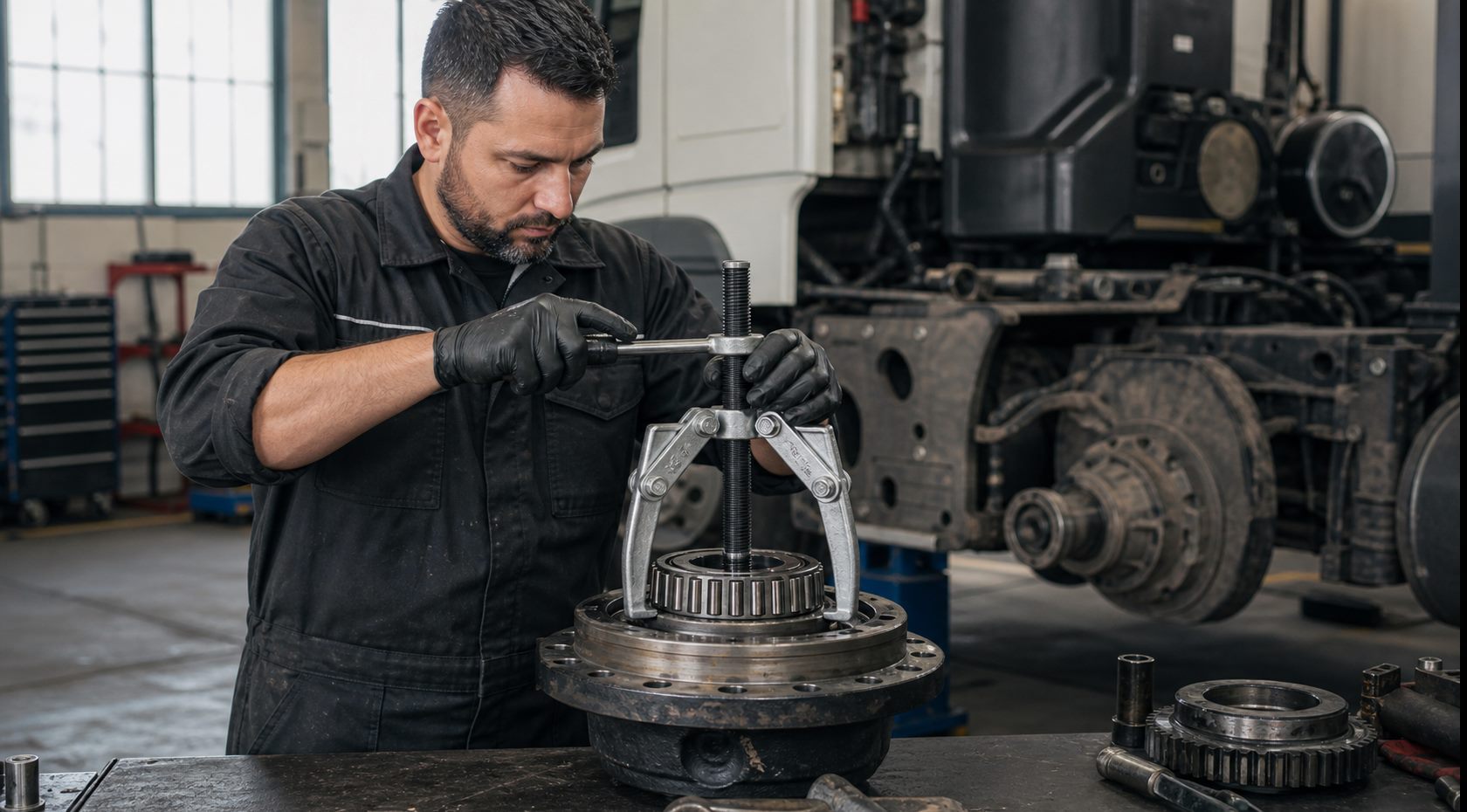
Truck bearings often sit in large hubs, transmissions, differentials, accessory drives, and support assemblies. Corrosion, press fits, heat cycles, and limited access can make removal difficult. Pullers apply axial force gradually, which gives the technician time to check alignment and stop before surrounding parts are overloaded.
A two- or three-jaw puller is suitable when the back of the bearing or component is accessible. Three jaws usually distribute force more evenly when clearance allows. Position each jaw behind a solid pulling surface rather than against a cage, seal, or thin shield.
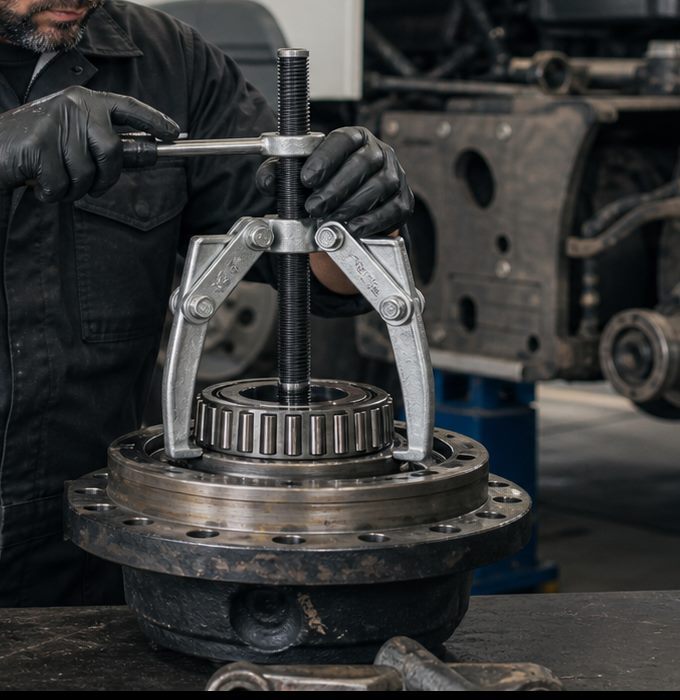
When a bearing sits close to a shoulder and hooks cannot get behind it, a bearing separator can create a secure pulling surface. Fit the separator squarely behind the bearing race, then connect it to a puller or a suitable forcing arrangement. Do not use a separator on a surface that cannot carry the extraction load.
Internal or blind-bearing pullers use an expanding collet inside the bearing bore. They are useful for components seated in housings where the outside edge cannot be gripped. Match the collet range to the bore and follow the vehicle or component service procedure for the correct pulling direction and support.
Hydraulic pullers are often considered for large, seized, or high-interference truck components because they can provide higher, smoother extraction force than a hand screw. Capacity alone is not enough: confirm the puller span, reach, support arrangement, and component-specific service limits before applying pressure.
Wear eye protection and keep people out of the line of force. Inspect puller arms, threads, adapters, and hydraulic hoses before use. Never exceed the rated capacity, heat a component unless the approved procedure allows it, or continue if the puller slips, bends, or loads a thin casting unevenly.
Stop when the bearing does not move under a reasonable, controlled load; the jaws begin to walk; the center point starts to damage the shaft; or a casting shows signs of stress. The correct next step may be a separator, internal puller, hydraulic setup, press fixture, or specialist support, depending on the component and service information.
After extraction, inspect the shaft, bore, shoulder, seal land, and removed bearing race for scoring, fretting, cracks, or heat marks. Clean the seating area and use the correct installation method for the replacement bearing. Pulling force should never be used to install a bearing unless the approved procedure specifically calls for it.
DNT Tools can help workshops and distributors evaluate puller configurations for truck bearing service, including external, internal, separator, and hydraulic solutions. For a setup question tied to your bearing size, access, and application, contact the support team with the component details.