- Ningbo Dongning Tools Co.,Ltd
- Professional Chinese Tools manufacturer on automotive speciality tools,bearing puller&heavy truck tools
- Address
- No.6 Falan Rd,Hengjie Town,Ningbo City,Zhejiang,China
- Phone
- +86-574-87216625
- info@nbdntools.com

Gearbox repair requires precise disassembly of bearings, gears, shafts, sleeves, races, and press-fitted components. Because gearbox parts are often installed with tight interference fits and limited working clearance, technicians need the correct bearing removal tools to avoid damaging shafts, housings, gear teeth, bearing seats, and sealing surfaces.
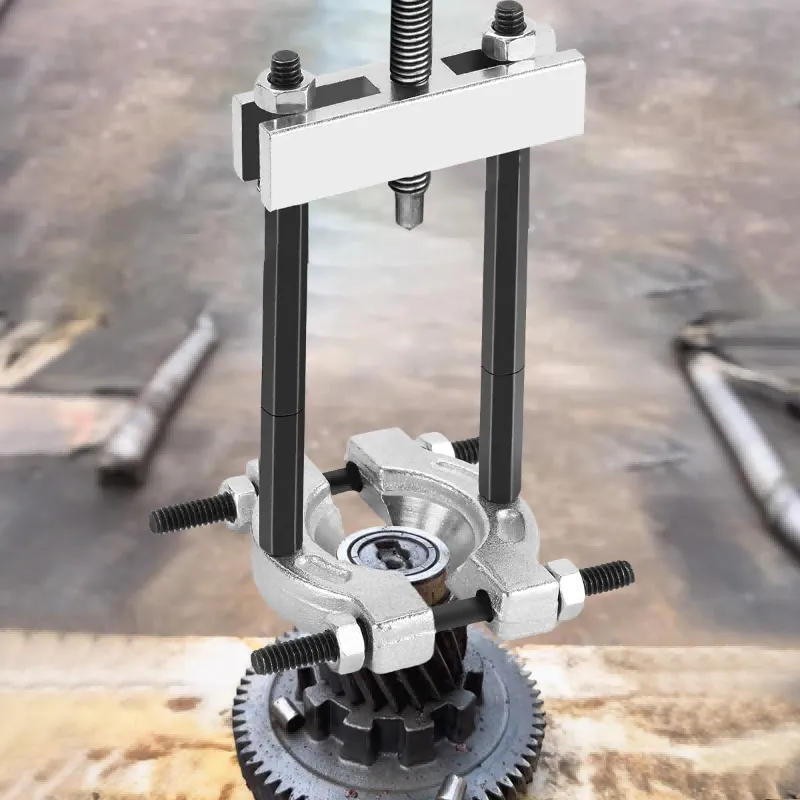
Bearing removal tools for gearbox repair include jaw pullers, bearing separators, internal bearing pullers, blind hole pullers, hydraulic pullers, slide hammers, press tools, and application-specific transmission fixtures. Each tool solves a different access problem inside the gearbox assembly.
Gearbox bearings operate under constant radial load, axial load, vibration, heat, and lubricant exposure. Over time, bearing races can become tightly seated on shafts or inside housings. Corrosion, fretting, heat cycles, and high mileage can further increase removal difficulty.
Using hammers, chisels, pry bars, or improvised tools can damage expensive gearbox components. A controlled bearing removal tool applies force in the correct direction, keeps the shaft aligned, and reduces the risk of scoring, bending, or cracking critical parts.
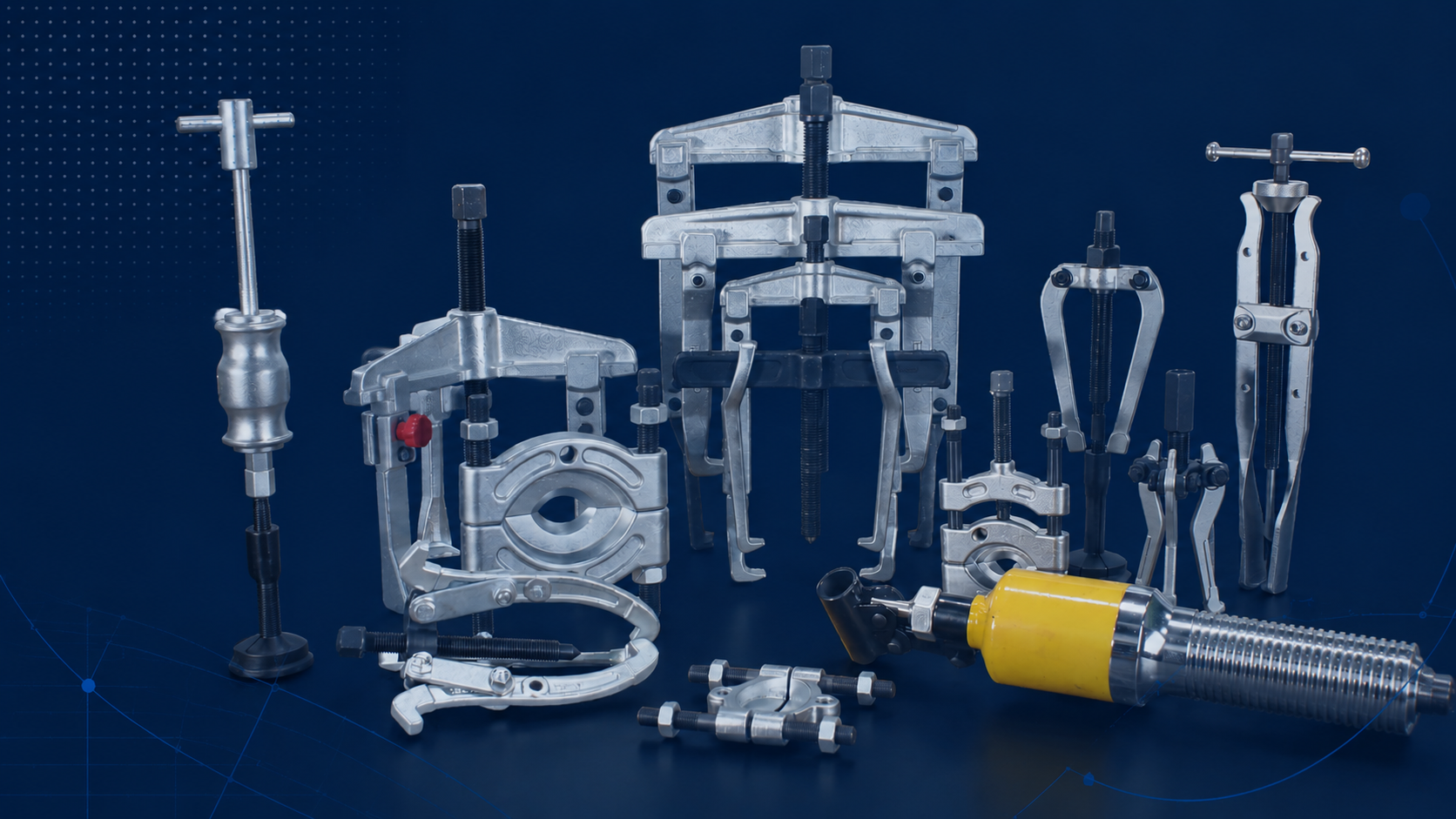
Mechanical jaw pullers are commonly used to remove exposed bearings, gears, pulleys, and sleeves from gearbox shafts. They use two or three jaws that grip behind the component while a central forcing screw pushes against the shaft end.
Two-jaw pullers are useful when space around the gearbox shaft is limited. Their narrower profile allows technicians to reach components positioned close to gears, housings, or shaft shoulders.
They are suitable for:
Small gearbox bearings
Accessible shaft-mounted gears
Pulley and sleeve removal
Compact transmission assemblies
The limitation is that two-jaw pullers provide less balanced force distribution than three-jaw designs. Accurate alignment is important to prevent slipping or side loading.
Three-jaw pullers provide better centering and more even load distribution. When enough clearance exists, they are preferred for removing larger gearbox bearings and gears because the three-point grip improves stability.
They are commonly used for:
Larger shaft bearings
Gear hubs
Couplings
Transmission pulleys
Accessible bearing races
Three-jaw pullers reduce the risk of tilting during extraction, especially when the component is tightly fitted.
A bearing separator, also called a bearing splitter, is one of the most important tools in gearbox repair. It is used when there is not enough clearance behind a bearing for standard puller jaws.
The separator uses two tapered steel halves that slide behind the bearing or gear. Once tightened, the separator creates a secure pulling surface. A puller bridge, forcing screw, or hydraulic system is then used to apply extraction force.
Bearing separators are used for:
Mainshaft bearings
Countershaft bearings
Pinion bearings
Gear hubs
Bearing inner races
Sleeves and collars
Bearings located close to shaft shoulders
They are especially useful when the bearing sits directly against a gear, synchronizer hub, or machined shoulder.
Internal bearing pullers are used when the bearing is installed inside a housing and the outer diameter cannot be gripped from outside. These tools expand inside the bearing bore and pull the bearing outward.
In gearbox repair, internal pullers are used for:
Housing-mounted bearings
Recessed gearbox bearings
Auxiliary shaft bearings
PTO housing bearings
Blind-positioned bearing races
Bushings and sleeves inside housings
Internal pullers often use expanding collets, bridge supports, forcing screws, or slide hammer attachments.
Blind hole bearing pullers are a specific type of internal puller designed for bearings or bushings installed in blind bores. In these applications, there is no rear access and no exposed edge for a standard puller.
The tool expands inside the bearing or bushing, locks against the internal surface, and extracts the component using either a slide hammer or bridge puller.
Typical gearbox uses include:
Pilot bearings
Blind-mounted gearbox bearings
Recessed bushings
Transmission case bearings
Bearings installed in closed-end bores
Correct collet sizing is critical. A poorly matched collet can slip, damage the bore, or fail to pull the bearing evenly.
Hydraulic pullers are used when gearbox bearings, gears, or sleeves require high extraction force. Instead of relying only on manual torque, a hydraulic cylinder generates smooth and powerful pulling force.
Hydraulic pullers are suitable for:
Heavy-duty truck gearboxes
Industrial gearboxes
Large transmission bearings
Seized gear hubs
Oversized shaft-mounted components
Bearings affected by corrosion or heat
Hydraulic pullers reduce technician fatigue and provide controlled force. However, setup must be accurate. The pulling force must remain aligned with the shaft centerline, and the tool must be rated for the expected load.
Slide hammer pullers generate impact-based extraction force. They are often used with internal bearing adapters or expanding collets.
In gearbox work, slide hammer tools are useful for:
Small internal bearings
Pilot bearings
Recessed bushings
Lightweight housing-mounted bearings
Components that need impact force to break free
Slide hammers are effective when space does not allow a forcing screw setup. However, they offer less controlled force than hydraulic or screw-type pullers, so they should be used carefully around aluminum housings and precision bores.
Gearbox bearings often leave inner or outer races tightly fitted after disassembly. Bearing race pullers are designed to remove these remaining races without damaging the shaft or housing.
They may use:
Thin jaws
Bearing separators
Clamping plates
Split collars
Puller bridges
Hydraulic assistance
Race pullers are especially important when removing tapered roller bearing races, pinion bearing races, and shaft-mounted inner rings.
Not all gearbox bearing removal is performed with a puller. Some bearings are removed using a hydraulic press together with support plates, press sleeves, and mandrels.
Press tools are commonly used when:
The shaft can be removed from the gearbox
The bearing can be supported correctly
The force direction must be highly controlled
The component requires pressing rather than pulling
A bearing must be installed after removal
Support fixtures are critical. Pressing against the wrong surface can bend shafts, damage bearing seats, or crack housings.
Many gearbox systems require application-specific tools. This is especially true for heavy-duty truck transmissions, automated manual transmissions, and commercial vehicle gearboxes.
Dedicated tools may be required for:
Input shaft bearings
Mainshaft gear hubs
Countershaft front and rear bearings
Synchronizer hubs
Range section bearings
Auxiliary shaft bearings
Clutch housing bearings
Output shaft bearings
Transmission-specific pullers are designed around exact shaft diameters, gear positions, bearing locations, and working clearances. A general-purpose puller may not fit or may apply force to the wrong surface.
Heavy truck gearboxes often require stronger and more specialized removal tools due to larger shafts and higher press-fit forces.
Common tools include:
Heavy-duty mechanical pullers
Hydraulic bearing pullers
Bearing separators
Long-reach pullers
Gear hub pullers
Internal bearing puller kits
Blind hole pullers
Press sleeves
Shaft support fixtures
Transmission repair tool cabinets
These tools are used in gearboxes such as ZF, Eaton, Allison, Scania, Volvo, and other commercial vehicle transmission systems.
The correct tool depends on the bearing position, access clearance, component size, shaft layout, and required force.
A bearing mounted on an exposed shaft may require a jaw puller or separator. A bearing inside a gearbox housing may require an internal puller or blind hole puller.
If there is space behind the bearing, a jaw puller may work. If clearance is limited, a bearing separator is often the better choice.
Small bearings may be removed with mechanical force. Large, seized, or industrial gearbox bearings may require hydraulic assistance.
The tool must grip a strong surface. Pulling from thin cages, fragile flanges, or incorrect bearing rings can damage components.
The pulling force should remain aligned with the shaft centerline. Misalignment can create side loading, bend components, or cause tool slippage.
| Selection Factor | Mechanical Puller | Hydraulic Puller |
|---|---|---|
| Force source | Manual forcing screw | Hydraulic pressure |
| Best use | Standard gearbox bearings | Large or seized bearings |
| Operator effort | Higher | Lower |
| Control | Good for small to medium force | Smooth high-force control |
| Portability | High | Moderate |
| Typical application | General transmission repair | Heavy truck and industrial gearboxes |
Most professional gearbox repair workshops use both mechanical and hydraulic removal tools.
Several mistakes can cause gearbox damage or tool failure:
Using a puller with insufficient capacity
Gripping the bearing cage instead of the race
Pulling through the rolling elements
Misaligning the forcing screw
Using a jaw puller where a separator is required
Applying force to a weak gear edge
Hammering the shaft after the puller is installed
Overheating nearby seals or hardened parts
Ignoring the manufacturer’s repair procedure
The best practice is to identify the bearing type, determine the fitted ring, choose the correct tool, and apply force gradually.
Gearbox components require precise alignment. Damage to shafts, housings, bearing seats, and gear surfaces can lead to noise, vibration, overheating, oil leaks, and premature failure after reassembly.
Using the correct bearing removal tools helps technicians:
Reduce disassembly time
Protect expensive transmission components
Maintain bearing seat accuracy
Avoid unnecessary replacement of shafts or gears
Improve repair consistency
Support professional rebuild quality
There is no single best tool for every gearbox bearing. Exposed shaft bearings may need a jaw puller or bearing separator, while housing-mounted bearings may require an internal or blind hole puller. Large or seized bearings may require hydraulic tools.
A bearing separator should be used when there is little clearance behind the bearing and standard puller jaws cannot grip securely. It is common in gearbox work where bearings sit close to gears, shoulders, or synchronizer hubs.
Yes. Hydraulic pullers are useful for large, seized, or heavily press-fitted gearbox bearings and gears. They provide high pulling force with smoother control than many manual methods.
A blind hole bearing puller or internal bearing puller is normally used. These tools expand inside the bearing bore and pull the bearing outward.
Hammering can damage bearing seats, deform shafts, crack housings, and transfer impact loads into precision gear components. Controlled pullers and press tools provide safer and more predictable removal.
Bearing removal tools for gearbox repair include mechanical jaw pullers, bearing separators, internal pullers, blind hole pullers, hydraulic pullers, slide hammers, bearing race pullers, press tools, and transmission-specific fixtures. Each tool is designed for a different bearing position, clearance condition, and extraction load.
Professional gearbox repair depends on selecting the correct tool for the exact bearing location and applying force in a controlled direction. The right tool protects shafts, housings, gears, and bearing seats while improving disassembly efficiency and repair quality.